 |
 |
 |
 |
 |
 |
 |
FOR COLLECTORS AND ADMIRERS OF THE WORK OF
DAVID ROBERTS RA.
Lord Russborough’s Annex has recently purchased an almost complete set of the
Standard Folio (first) Edition [SE] of
David Roberts Views from the Holy Land, Syria, Idumea, Arabia, Egypt & Nubia
Double tinted chalk-stone lithographs, printed by Louis Haghe. Published F. Moon,
London 1842-49
One of only 500 sets issued, of which it is estimated only 110 – 125 survive.
We take pleasure in offering for sale these exquisite images for individual sale, affording what may be a once in a lifetime opportunity for our clients to purchase a long sought print at a very affordable price. Aside from cleaning, we take pleasure in offering our images as David Roberts, Louis Hague & Francis Moon intended them to be seen.
Although termed uncoloured which implies black and white, the complicated process of printing used two tint stones over grey so the finished image can in fact have quite a number of subtle tones of colour within it. Our images have no added hand colouring, which some dealers add to enhance their selling price, but thereby create a variant that was unauthorized. Moon did issue a limited number of sets with added hand tinted highlights as part of the Royal Subscription Edition [RSE] and these are the only authentic original hand tinted images, and they command a considerable higher price.
We occasionally have some authentic RSE edition images available, and also SE edition images, with later added hand colouring, which is clearly indicated in our description.
Please contact us regarding the availability of images relating to an area of interest to you (see detailed index) and we shall be pleased to send you details.
We guarantee the authenticity of every work of art we sell 100%. All our images come with full cataloguing details and background documentation.
|
 |
 |
 |
 |
 |
 |
 |
 |
 |
 |
 |

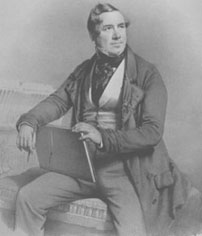
David Roberts RA.
Scottish 1796 - 1864
Sometimes known as the Scottish Canaletto. Apprenticed as a house
painter but after a successful early career as a painter of theatre
scenery Roberts turned to fine art and specialized in architectural
and landscape subjects, both in oil & watercolour.
His early training instilled within him an eye for, and sense
of dramatic composition, elements of which appear in all his works.
He was one of a number of inveterate artist/travelers who catered
to the insatiable Victorian taste for topographical scenes of foreign,
especially exotic places, as their knowledge of the world increased
along with the expansion of the Empire. His reputation was already
well established (having exhibited in the RA. from 1826-64 and
BI. 1825-59) by the time he arrived in Egypt and the Holy Land
in 1838.
Public acclaim for both his exquisite lithographs and commissioned
paintings made him a wealthy man. He was elected a member of the
Royal Academy in 1844. His travels continued until his death from
a stroke in 1864.
It is the overriding sensation of sober and finely proportioned
grandeur that permeates every piece of work by David Roberts; his
unmistakable descriptive attention to detail that infuses even
the humblest of subjects with dignity, that instinctively make
his works readily familiar and recognizable to art experts, art
lovers and untrained connoisseurs alike.
His views have inspired many a Christian to visit for themselves
the sites of Christendom that he portrayed so superbly Indeed it
is true to say that Roberts' renderings have been so inspiring
that from their release in Victorian times that many, from the
mighty to the humble, have felt that they too have traveled to
the Holy Land, albeit vicariously - a significant achievement for
a Scottish house painter touched by genius.
The few remaining Roberts views in circulation from the original
500 have proven to be a sound investment in art.
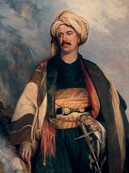
Roberts in Turkish Dress by Scott Lauder
|
|
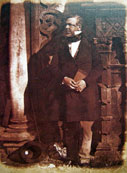
Photograph of David Roberts
|
|
 |
 |
 |
 |
|
 |